


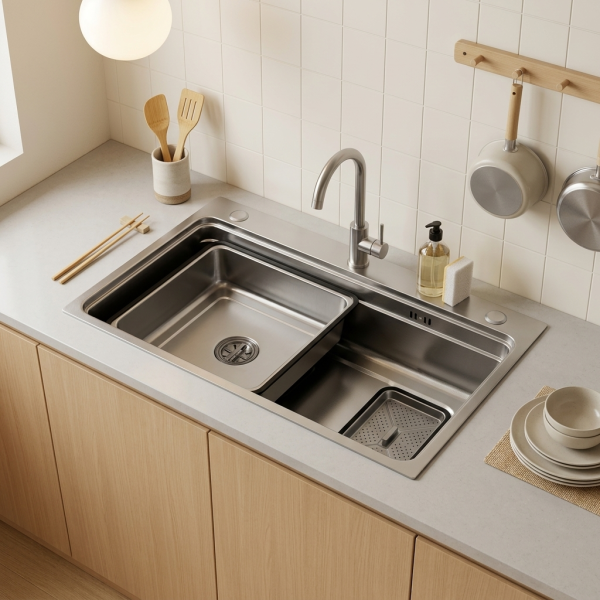
What teams should discuss before adopting a round kitchen sink purely as a structural inspiration
Problem-driven opening: why this conversation matters
Teams often applaud a round silhouette for its aesthetic clarity and brand differentiation, but design decisions framed purely as “structural inspiration” hide practical trade-offs that derail projects. Start by asking whether the round form is a visual motif or a functional constraint; the wrong answer forces costly workarounds. If your brief even hints at integrating a double kitchen sink, halt and scope the implications first—flow, fabrication, plumbing runs, and user ergonomics change in direct, measurable ways.

Core risks teams routinely underplay
Round geometry changes load paths and countertop cut-out complexity; it complicates mounting and sealing details and can demand custom brackets or thicker countertop substrates. Maintenance suffers when cleaners designed for linear corners can’t reach curved junctions. Accessibility and ADA compliance drift off-plan because standard accessories (racks, grid drains, disposal alignments) assume rectilinear baselines. Overlooking these issues turns an evocative gesture into scope creep, budget overruns, and a product that looks good on renders but fails in daily use.
Concrete questions to drive the discussion
Ask sharp, actionable questions: Who uses the sink and how many daily cycles do we expect? What tolerances can our fabricator hold for curved seams? How do fixtures—faucets, soap dispensers, disposals—align with a circular profile? What standard drain and strainer assemblies are compatible, and what cost premium do custom pieces carry? What is the impact on warranty and long-term serviceability? Each question links to a design decision; answer them before committing to the silhouette.
Experience and evidence from the field
As a kitchen architect who’s specified hundreds of bowl configurations for both restaurants and homes, I’ve seen aesthetic-first choices escalate into operational failures. Look at high-volume restaurant kitchens in New York City: chefs and service teams prioritize wash-station throughput and cleaning access, which is why the double bowl stainless steel kitchen sink remains a prevalent choice there—its geometry supports segregation, high flow, and compatible standard fittings. That real-world pattern is reflected in industry guidance and case studies from commercial kitchen projects.
Alternatives and trade-offs worth debating
Round inspiration doesn’t force you into a fully circular sink. Consider three paths: 1) a visual-only motif—retain standard rectilinear bowls but echo circular themes in faucet escutcheons or countertop drains; 2) hybrid bowls—rounded corners with standard rectangular baselines to preserve accessories; 3) a fully custom round bowl—accept higher fabrication and service costs in exchange for differentiation. Evaluate cost, lead time, maintainability, and user ergonomics for each. Don’t let brand novelty trump operational needs.

Common pitfalls and how to avoid them
Teams often skip early shop-checks, assume standard hardware will adapt, or defer plumbing coordination until after final fabrication. Avoid these mistakes by locking down three things before design freeze: verified fittings list with vendor sign-off; a prototype or mock-up for ergonomics and cleaning trials; and a maintenance plan with replacement-part sourcing. Small upfront tests prevent late-stage, expensive fixes.
Decision framework to keep the debate productive
Frame decisions around measurable criteria: user throughput (cycles/hour), cleaning intervals, retrofit complexity (hours on site), and spare-part availability. Score options against those criteria. When aesthetics score high but operational metrics fall behind, insist on mitigations—modular panels, accessible seams, or standardized drain geometry—that align the round motif with day-to-day realities.
Closing synthesis that connects design intent to supply
Commit to the round sink conversation as a problem to solve, not a look to justify. When teams move from rhetoric to requirements—defining users, testing ergonomics, and confirming fittings—they preserve the visual idea without sacrificing functionality. That balance is precisely what practical suppliers bring: informed solutions that respect form and function, as shown in contemporary sink options from manufacturers like AOGLAN, where specification choices live alongside service and sourcing considerations for durable, maintainable installations.
